

The brain outside the cloud
Photos, memory, and the weight of always having an audience

I started watching the 2026 reboot of Little House on the Prairie. If you grew up with it (yeah, I'm from that time), you probably remember the original from 1974, still streaming today.1
And I noticed something that inspired me to write this article. The whole story began as a memory. Laura Ingalls Wilder wrote the books decades after it all happened, as an adult, reconstructing her childhood from memory, with no photos and no diary entries to check it against.
In the first minutes of the new show, Laura, the younger daughter, explains why the family is leaving everything behind for somewhere none of them have ever seen, and that they’re happy anyway, because they’re together. It's 1869. There's a wagon, and a kid trying to make sense of the size of it all while the landscape rolls by.
At that time, the only place to keep any of it was your own head. Births, losses, an entire season of a life, and the only thing that survived, decades later, is what Wilder remembered to write down. That's how it worked for everyone who ever lived, before recording your own life was something anyone could actually do. Every moment, good or bad, lived in memory first, and got passed down by mouth, then eventually by pen.
That made me think of something else, when I was clearing out my phone this week.
That family, like pretty much any family before the 20th century, didn’t have two things we can’t seem to put down today: a place to store memory outside your own head, and a distant audience. Those two absences touch two completely different systems in the body: how memory forms, and what the nervous system does the moment it senses an audience, even an imagined one.
Memory needs exercise too
So, I finally decided to delete stuff from my seven-year-old iPhone 11 (I’m not an upgrade-every-year kind of person, and around here that makes my phone practically a museum piece). It reached 254 GB out of 256 (I took that screenshot after starting to clean it up). I had 20,000 photos (mostly from trips and of my dog, Chico), plus videos, screenshots, and many other things I had accumulated over the years. Apps had stopped updating, and some had already died.
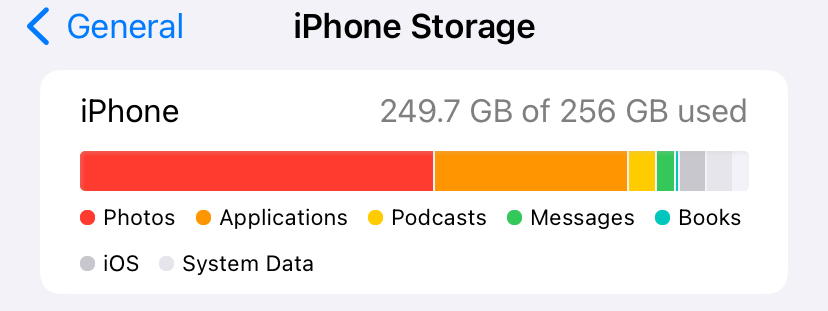
It stung a little, but many things were deleted, and many others moved to the cloud in an afternoon. And my first thought was: I hope that’s all saved. Anyhow, seeing all that free space on my phone brought a real, physical sense of relief. I even slept better that night.
I also thought: how many of those 20,000 items am I ever going to look at again?
In 2006, Henry Roediger and Jeffrey Karpicke at Washington University in St. Louis tested a counterintuitive idea. They found that it’s much better to recall something from memory from scratch than to reread it. Reread a passage four times, and you’ll remember 40% of it a week later. Try to recall it from scratch instead, and that number jumps to 61%. The struggle of pulling information out of your own head is the thing that makes it stick.2
That’s called retrieval practice, and it’s the exact opposite of snapping a photo and never opening the folder again. A photo can reduce the need to pull the memory back up, and that act of pulling is part of what strengthens it.
Yaakov Stern at Columbia University studies the same idea from the angle of brain aging. He calls it cognitive reserve. There’s still debate in the field over what’s cause and what’s effect, but people who use their brain actively, testing it, revisiting old material, and practicing, tend to hold up better against age-related decline.3
It’s “use it or lose it” applied to the brain, the same rule we already accept for muscle without a second thought. Memory works the same way.
Families in the past didn’t get a choice. Every memory worth keeping had to be told again and again just to survive, and decades later, some of it became a book. Wilder trained this her whole life without calling it training.
Before shopping for a better photo app or a more reliable cloud plan, try a smaller question first, the thing I tell you every few months: subtraction before addition. What happens if you try to remember before you check? I’m not giving up travel photos, or photos of Chico. But this week, before opening the folder, I tried to rebuild the moment first: the smell of the place, maybe the sound of it, or how my body felt when I was there.
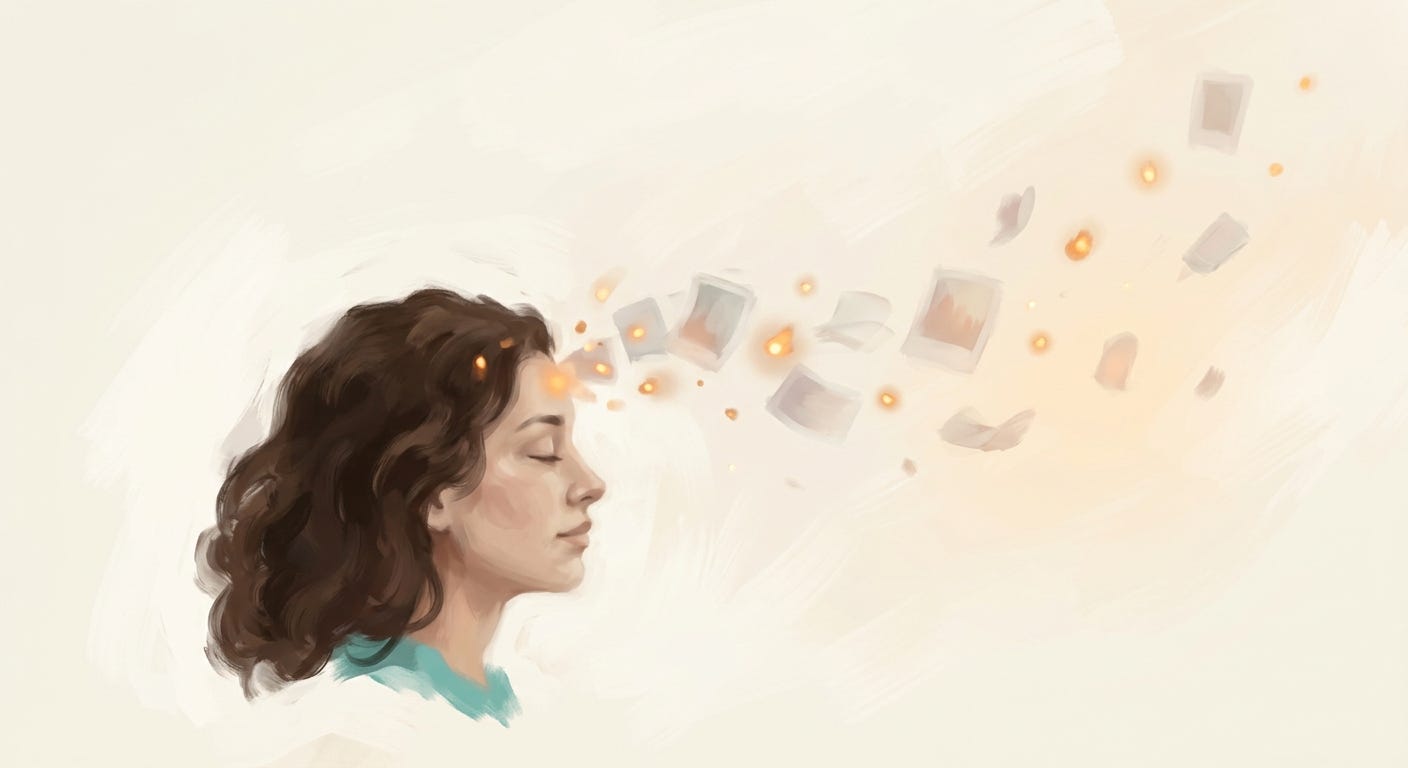
Memory comes back in scattered cues, and the more of them you can reach, the easier the rest comes back. Some days it came fast. On other days, I realized I’d only kept the picture, and the moment was long gone.
When nobody’s watching
My own cleanup turned up an embarrassing number of screenshots and photos I’d saved and favorited “for a future Substack post,” or “to post somewhere eventually.” Not one of them got used, posted, or even was shown to another person. They were just sitting there, waiting for an audience I invented myself. Call it a perfect dead file, a folder named “ideas for later” that nobody, including me, ever opened again.
Researchers Kristin Diehl, Gal Zauberman, and Alixandra Barasch looked into whether cameras ruin the moment. Taking photos usually makes an experience more enjoyable, because it pulls you into it. The catch is why you’re doing it. Once the photo is meant for sharing, self-presentational concern kicks in. You start seeing the moment through other people’s eyes, and that takes you a step out of it. The audience you start picturing pulls you out more than the camera itself does.
Sally Dickerson and Margaret Kemeny reviewed decades of stress research and found the same pattern on the hormonal side. Being judged, being watched and evaluated, spikes cortisol harder than physical danger does. The body can’t always tell the difference between a real audience and an imagined one4. Which is the same logic behind the vagus nerve, mentioned a bit in this previous article.
There’s a nervous system state that only shows up when there’s almost zero threat of being evaluated, real or imagined. That prairie family lived there constantly. Nobody in the 1870s had figured out polyvagal theory. They just had no audience at all, so there was nothing left to guard against.
My “for later” files did the opposite of that, on both counts. I took the photo already picturing someone seeing it, then never let anyone see it, so I got neither the payoff of sharing nor the calm of having no audience at all, just a few years stuck in the middle, sitting on a phone.
The autopilot part is snapping the photo already picturing someone seeing it, before you've even decided if you're posting it at all. (No judgment on the photos themselves, Chico is really photogenic.)
Three things worth trying
None of these mean giving up photos. None cost a thing. They’re just about where your attention sits while it’s happening.
Before opening a photo, try rebuilding the moment from memory first, out loud or on paper: what the light looked like, who else was there, or maybe the first thing someone said. It can be uncomfortable at first. But it's the only way to actually use memory instead of just outsourcing it, and that effort is what keeps cognitive reserve alive as you age.
Take the photo if you want it, of course. Just wait a bit before opening the app to share it. Stay in it first, decide on an audience later. Those few extra minutes keep your body out of alert mode.
Next time, skip the photo and tell someone the story out loud instead. Saying it forces you to build it into words someone else can follow, which asks more of memory than a photo ever will.
Back at the prairie
I already know how this family’s story goes. I grew up on the books and the old show, and I’ve just finished the first season. I still want to keep watching.
And maybe that’s the point. Coming back to a story and noticing what you missed the first time is its own kind of draw, separate from how it ends. That kind of noticing takes engagement. You pay more attention and catch what you missed.
Cognitive reserve research ties that kind of engagement to staying sharp at 80 and beyond. Next time something’s worth holding onto, give your own head a first shot at it, before your phone gets a turn.
If you are curious, you can stream the classic 1974 series on Peacock, Amazon Prime Video, and Pluto TV. The new 2026 adaptation is on Netflix.
Audio interview: Cognitive Reserve – A Conversation With Dr. Yaakov Stern
Love this piece Claire – a big yes! to keeping more neurons firing :) and my husband and I share an iphone 11...my family insists I carry a 6 for back-up when I travel on my own, talk about dinosaur.